In 1998 I was the Executive Chef at the Lancaster Country Club. One of the perks was a trip to the Culinary Institute of America in St. Helena CA. Housed in the former Christian Brothers Winery, in the heart of the Napa Valley, this was a continuing education institution and I was registered for a nutritional cooking class. The Club, generously paid for Linda to accompany me. This was our first trip to California and was to be Linda’s first flight. After I booked the trip, I did not mention that our first flight was a commuter from Harrisburg to Cleveland. I thought that I could alleviate her worrying about a small plane, until it was too late. As we walked across the tarmac to the plane, Linda clenched my hand and incredulously said, “This is OUR plane?“

The plane held about 24 passengers and we were seated just behind the cockpit. The cockpit door was open and we had a clear view of the pilots doing their checklist. Linda’s attention was riveted to the process, especially when one of a series of lighted switches did not turn red to green, as the pilot repeatedly toggled it back and forth. Her anxiety grew when the co-pilot was heard to say, “I’ll go check it”. Leaving the plane, a few bangs and slamming of doors commenced. Linda, crushing my hand at this point, is repeating, “Something is wrong with the plane, something is wrong with the plane!!” As the co-pilot stepped back on the plane, he announced, “Luggage door wasn’t properly latched, all good now.” This eased Linda somewhat, until the engines started. If you have flown in one of these small propeller commuters, you know how loud it is, this was understandably disconcerting for my wife. But she eventually settled in, with Linda calm and enjoying the experience, the rest of the flight and the next one to San Francisco went by uneventfully,.
Arriving in San Francisco, we procured our rental car. We only had one day to spend in the city, so like a typical tourist, we drove to Fisherman’s Wharf. Getting an early lunch, we noticed the Grayline Tours close by. If you only have a limited time in any city and want to get a good overview, I recommend taking one of these tours. In San Francisco, the buses resembled the famous trolley cars. Our driver/guide was amazing. Showing us all the famous spots, including local history, his narrative was highly entertaining. At one point as we were flying down a hill, (the steepness of the San Francisco hills must be experienced to be appreciated), he started screaming “No Brakes, we got no brakes“, before screeching to a stop. As we approached a trolley stop, he talked about how long the waiting line is at this particular stop. He rehearsed us in the Rice’a’Roni jingle, saying these people have been waiting an hour or two, we need to entertain them. As we drove along the line, the entire bus sang the song, complete with the driver’s timely bell ringing. After two hours of a greatly entertaining and informative tour, we were returned to Fisherman’s Wharf.
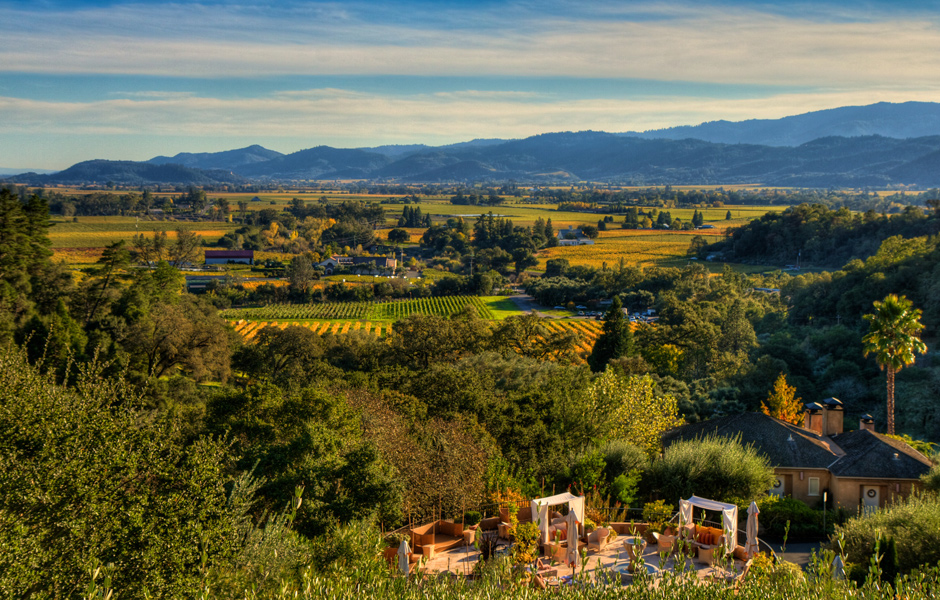
We departed San Francisco, crossing The Golden Gate Bridge, for the hour and half ride to Calistoga at the northern end of the Napa Valley. We were booked into Dr. Wilkinson’s Resort and Spa. The resort was on the main street of Calistoga, a small quaint village, seemingly straight out of the Sixties. Across the street was a small airstrip with a number of gliders being pulled into the sky.
The Napa Valley rests between two ranges, the Vaca Range to the east and the Mayacamus to the west. When we arrived, shortly after a minor shower, there was a double rainbow, stretching from one range to the other, magical. The valley is only five miles wide, and Calistoga was at the northern end, the mountains looming on either side, always the first thing that I looked to when leaving our cottage. Dr. Wilkinson’s was known for it’s mud bath’s and hot spring, mineral water pools, Three in total, all different temperatures. Years later, Mike Rowe and “Dirty Jobs” would film an episode at the resort. A few blocks behind the resort stood the Calistoga High School, first head coaching job for former Eagle’s coach, Dick Vermeil.
Linda and I enjoyed wine, but we were not expert’s by any stretch of the imagination. I had two winery guides, hopefully, helping us to decide which wineries to visit. We had arrived on Saturday, giving us all Sunday to explore, before I started class on Monday. Eschewing breakfast, we headed out, guides in hand, a bit nervous, as we didn’t want to been seen as know-nothing rubes. With no clear destination in mind, we drove south on 128, through St. Helena. Seeing a sign for Sullivan Vineyards and not recognizing the name, I thought, they’re not in either book, shouldn’t be to intimidating.

A large red barn stood next to a beautiful, large estate house. The barn contained the winery, there were no cars in the lot. Entering we were greeted by a series of very colorful original artworks and a tall, sandy haired 30 something man. He greeted us and I told him we like wine, don’t know much about it and I was a chef, attending a class at the CIA. He said that he was working at Sutter Homes during the week, a large winery in St. Helena, known for it’s inexpensive table wines. He worked weekends at Sullivan to learn more about fine wine making. He explained the history and philosophy behind how the Sullivan family produced their wine. Not irrigating as some wineries would do, relying on nature to help produce their excellent wines. He also mentioned that the artwork was done by one of the Sullivan daughters. Sullivan he explained, was classified as a boutique winery, which meant it produced less that 5,000 cases a year. He showed us the huge stainless steel fermentation tanks, and introduced us to the owner’s son, Jim, who was on top of one of the tanks, pumping the fermenting liquid from the bottom to the top, this is called “pump over“. Simply, the grape skins float on the top of the tanks, juice below. The juice is relatively clear, so they need to remix with the skins to attain red color.
Jim came down to join us, hearing our story, he says, “Well, you need to taste a flight. I will guarantee that you will not taste a better wine in the Valley, including Opus One.” Now Opus One was, and remains one of the world’s premier red wines. So this was a pretty audacious statement, more on Opus One later. He then proceeds to pour 5 glasses of different vintages for each of us. These pours were not the small 1-2 oz portions usually given in a tasting room. These were full glasses of wine, remember, this was still Sunday morning, we hadn’t eaten. But, the wine, good lord, the wine, even to my and Linda’s uneducated palates, it was life altering. Halfway through the flight, the large side doors of the barn slide open, in entered a short Mexican man and woman in field clothes and straw hats. Jim introduced us, this was the head field hand and his wife. After handshakes and smiles, they joined us for a taste. It seemed like a reunion of old friends.
We were now a bit in our cups and very disappointed to learn that this wine was not available in Pennsylvania, but we could purchase there. Linda wanted to buy a case, but realizing that each bottle was 60 dollars we settled for two. The friendliness and easy manner that we experienced in this first visit, went a long way to ease any apprehension that Linda and I had about our inexperience. It did not turn out to be unique. We experienced that same eagerness and affability at all the wineries we visited.
Monday at 5:45, I left our cottage to go to class. Walking outside in the late September air, the smell of wine must permeated my nostrils. This was harvest time, the smell of grapes and the start of the fermentation process was a constant presence.
Class
A day at class started at 6:15, when I and my classmates would meet for breakfast and lively conversation. The class roll included chefs from Disney World, Penn State, Frankenmuth’s Bavarian Inn in Michigan, hospital and country club chefs and various corporate chefs. A very diverse group, with various backgrounds and experiences, but all sharing the same problems and satisfactions that are common to being a chef.
Class proper started at 7 am with a one or two hour lecture by Chef Connie Gutterson, a nutritionist. These presentations provided a strong general knowledge of nutritional basics and the requirements needed to provide a healthy diet. She touched on the Mediterranean diet and the French Paradox, how the French attain low cholesterol and low incidence of heart disease, despite an unhealthy diet. One or two alcoholic drinks a day, wine in most cases, is credited with this paradox.
The last part of the lecture was handled by our main instructor, Chef Catherine Brandel. Chef Brandel stressed using the freshest and best ingredients. She focused her discussions on the techniques used for healthy cooking, steaming, braising, grilling and toasting. Her experience working at Chez Panisse for thirteen years gave her instant credibility. Chez Panisse was Alice Water’s internationally renown restaurant in Berkeley, CA. She and the restaurant, were known for the use of locally grown and organic produce, the start of the farm to table cuisine. Alice was essentially, the first celebrity chef.
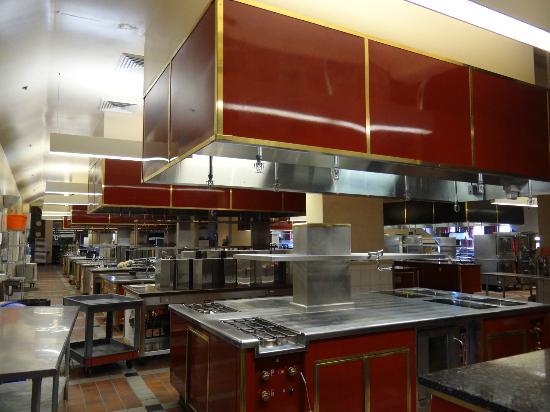
As the lectures ended, it was time for the kitchen. We formed teams, mine consisting of Suki, a personal chef from NYC, Helmut, Corporate Chef for Milliken & Coo. in South Carolina and myself. Truthfully, because I had not been to a traditional school, I had been apprehensive leading up to the class. As it turned out, my skills and knowledge were equal and in most cases, superior to my classmates. This was verified, when both Suki and Helmut requested that I captain the team.
Every day, each team was assigned three or four dishes to prepare, examples included, Quinoa Stuffed Tomatoes, Sea Bass in Salt Crust, Chile Grilled Tuna with Korean Style Salad, Grilled New Potatoes with Mustard Seed and Tabasco. Directing my team, we would produce enough of each dish to feed a dozen people and one of each dish, plated for critique.
During the hectic preparation time, both Chef Gutterson and Brandel, busy giving instructions and advice, also insuring that we were adhering to the healthy guidelines discussed earlier. Each team worked at their own, French made, Bonnet cooking islands. Which seemed quite wonderful, but the controls for the burners and ovens were behind small doors, making them a bit cumbersome.
In other sections of the vast kitchen complex, other classes were in session. There was the Culinary Career Exploration class, (we called them the meat class.) Roasting, sautéing and frying a daily assortment of protein. Weiner Schnitzel, Filet Mignon, Racks of Lamb, Prime Ribs, an carnivore’s dream. There was a group from Pillsbury, preparing Mexican cuisine, using their branded products. Finally, a baking class, providing, breads and desserts.
At noon, a gong in the middle of the complex was sounded. This brought buffet style trays, laden with the morning’s assignments from each class. All classes sat, en masse, for lunch. It was an overwhelming amount of food.


Lunch over, we returned to our stations, where our instructors and fellow classmates critiqued our dishes. Comments on taste, presentation and preparation were all included. We now reviewed our assignments for the next day, completing any prep needed, cleaning our stations, at two pm we were done.

There were two excursions we took as a class, One was to the St. Helena Farmers Market. It was here, in this open air market, that I was introduced to Alice Waters, by Chef Brandel. She signed my copy of her cookbook, “Chez Panisse Vegetable”, which remains a treasured part of my library. She also asked the class a question, which time has erased from my memory. I do remember, that I answered correctly and was rewarded with a bag of pistachio nuts.

The other excursion for a handful of my classmates was private tour of the Opus One Winery. This winery was created in 1980 as a collaboration between Robert Mondavi and Baron Phillipe de Rothschild of Chateau Mouton Rothschild, American and French winemaker icons. The goal was to combine old word and modern techniques to produce a Bordeaux style blend based on a Napa Valley Cabernet. This collaboration resulted in a beautiful winery and an award winning highly prized wine, Opus One. At that time, it was the only wine they produced and remains the highest priced Napa Valley wine. Limited production caused an allotment system, assigning a finite number of cases of each vintage to each city and state.
Five classmates and I arrived at the winery and were shown to the Salon. The Salon was ornately decorated with antiques, we were to learn, from the Baron’s estate. The docent, was the only wine related person, that I met, who was a little stuffy. Little stuffy, downright arrogant. She had an affected New England accent and spoke with her head tilted to the ceiling. Looking downt down her aquiline nose, she pointed out the furnishings. “This mirrar, was a gift to the Baran de Rothschild, from Catharine De Medici oann the occasion of his wedding in 1573, it is valuued at 27,000 dollarrrs.” Pointing to a chair, in which the Chef from Penn State was reposing, “This is a Louis XIV chair, valued at 12,000 dollarrrs.” The Chef sprung form the chair as if propelled, exclaiming, “I ain’t sitting in no 12,000 dollar chair!”

After a tour of the production facilities, we descended by elevator to the tasting room. The room had full length windows, looking out on the circular barrel room. We walked into the barrel room and the docent related, “It is a pity that you are not here in January, we fill one barrel with cheese cloths, opening in January and rubbing the middle section down, creating beautiful, burgundy colored stripes.” Now, a barrel of wine contains 80 bottles of wine, quick multiplication, at 120 dollars a barrel, comes to 9,600 dollars. Ever the pragmatist, I was forced to ask, “Why, does it somehow affect the wine?” I was truly curious. With a dismissive wave of a long fingered hand, I am told, “We simply enjoy the aesthetics.” So there, you unsophisticated boor.
We had our tasting, much to my amusement, while it was extremely good, Jim Sullivan was correct, his Cabernet WAS superior to Opus One. In the interest of not having the docent sic the hounds. I refrained from sharing that knowledge.
Dinners and Wineries
The free afternoons and evenings allowed us to visit other wineries and sample the Napa Valley’s assortment of fine restaurants. The memorable ones:
- Tra Vigne in St, Helena. Right next to the Marywood Winery, where, in the twilight, we watched the off loading of wagons full of grapes. The grapes augured to remove stems. Tra Vigne was Calabrian influenced, owned by Michael Chiarello, who later starred on the Food Channel. I had Grilled Sonoma Rabbit with Teleme layered potatoes, oven dried tomatoes and mustard pan sauce. We shared a nice bottle of Sangiovese
- Catahoula’s in Calistoga. Their open wood fired oven, produced a memorable Planked Harissa Glazed Salmon, with Roasted Pepper Couscous and Smoky Tomato Broth.
- Auberge du Soleil. Located on the side of the Vaca Range, looking west over the valley as the sunset. Billed as the best restaurant view in Napa, it did not disappoint. Nor did the Horseradish Grilled Ribeye with gouda scalloped potato and roast cipollini relish
- Napa Valley Wine Train. Surprisingly good Prix Fix dinner, including, Sonoma Rack of Lamb Achiote, Lamb Rack, rubbed with achiote paste, grilled over mesquite, served with Chipolte Pepper Demi Glace
Wineries we visited
- Francis Ford Coppola, display of movie memorabilia and his Oscars
- Clos de Pegase, nice wine, sculpture garden
- Sutter Home, touristy spot, beautiful old home and grounds
- Mondavi, a must see
- Rest lost to memory
Fog and The Thunderbirds
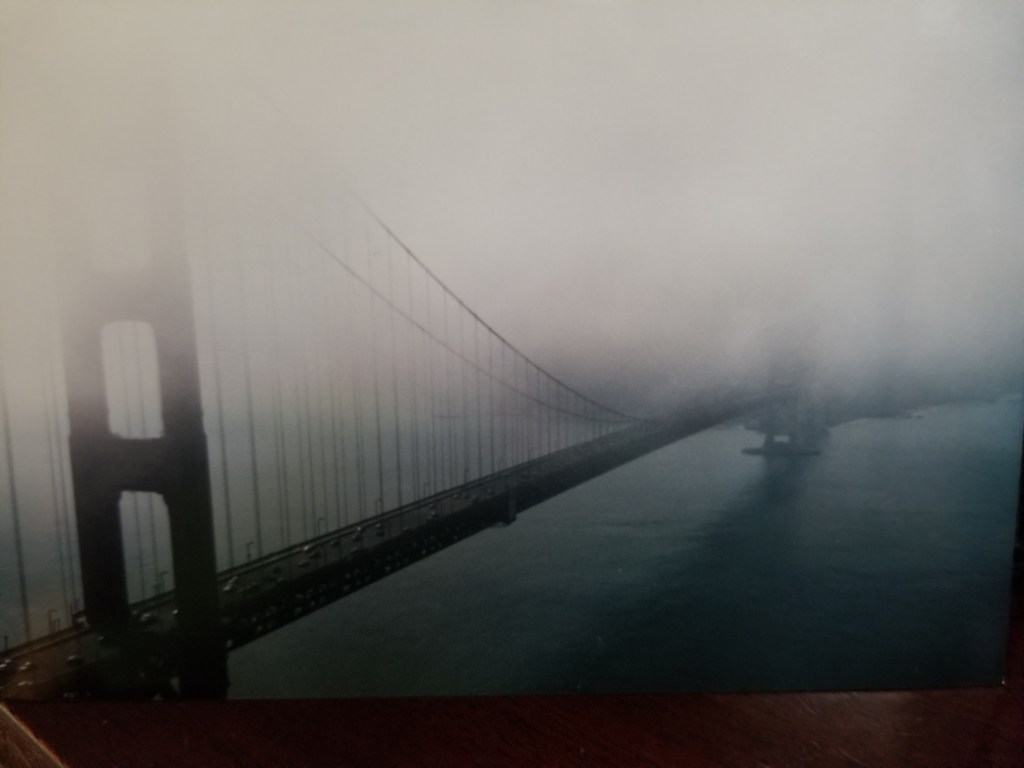
After a fantastic week, it was time to go home. I decided to take a different route home, going through the Sonama Valley and hugging the coast to San Francisco. As we approached the northern end of the Golden Gate, hills to the west shielded us from the Pacific Ocean. The top of these hills were shrouded in a thick, rolling fog. As we continued down the highway, the fog descended down the hills and splashed onto the road bed. It was if someone had taken a pitcher of fog and poured it down the hills. Descending with purpose and velocity, the fog hit the roadbed, rebounding into to air, explosion like. Cautiously driving my rental burgundy Buick LeSabre, through this cascading cloud, we reached Battery Spencer, a park above the Golden Gate roadbed. Pulling in, we wanted to get some pictures from this vantage point.
To the right was the fog shrouded Pacific, hidden from view. To the left stood San Francisco Bay, bright and sunny, crystal clear. Directly in front and below us stood the famed Golden Gate Bridge, emerging like a goliath from the fog. As we are snapping a few pictures, we hear a roaring from the Pacific. The sound growing as the fog increasingly lifts, the bridge become clearer by the moment. And then, bursting out of the dense fog to our right, are the Air Force Thunderbirds, their F-16’s in tight formation. Flying below us, they streak under the roadbed of the bridge and into the bright sun of the bay. Over the bay, they ascend, breaking into a fluer de lis. I still get chills whenever I relate this story. One of the most amazing sites I have ever witnessed. A cap on a once in a lifetime trip.
 Chuck's Stories